// House Types

Three house types.
UK data.

All footprint data is based on published UK average floor areas from DCLG housing statistics. Dimensions are ground-floor footprints only — not total floor area.

Quick Comparison

TypeSq FtBedroomsFootprint (approx)

Bungalow

Single Storey

828771–29.3m × 8.4m

Semi-Detached

Semi-Detached

1,0339638m × 12.9m

Detached

Detached

1,582147412.5m × 11.8m
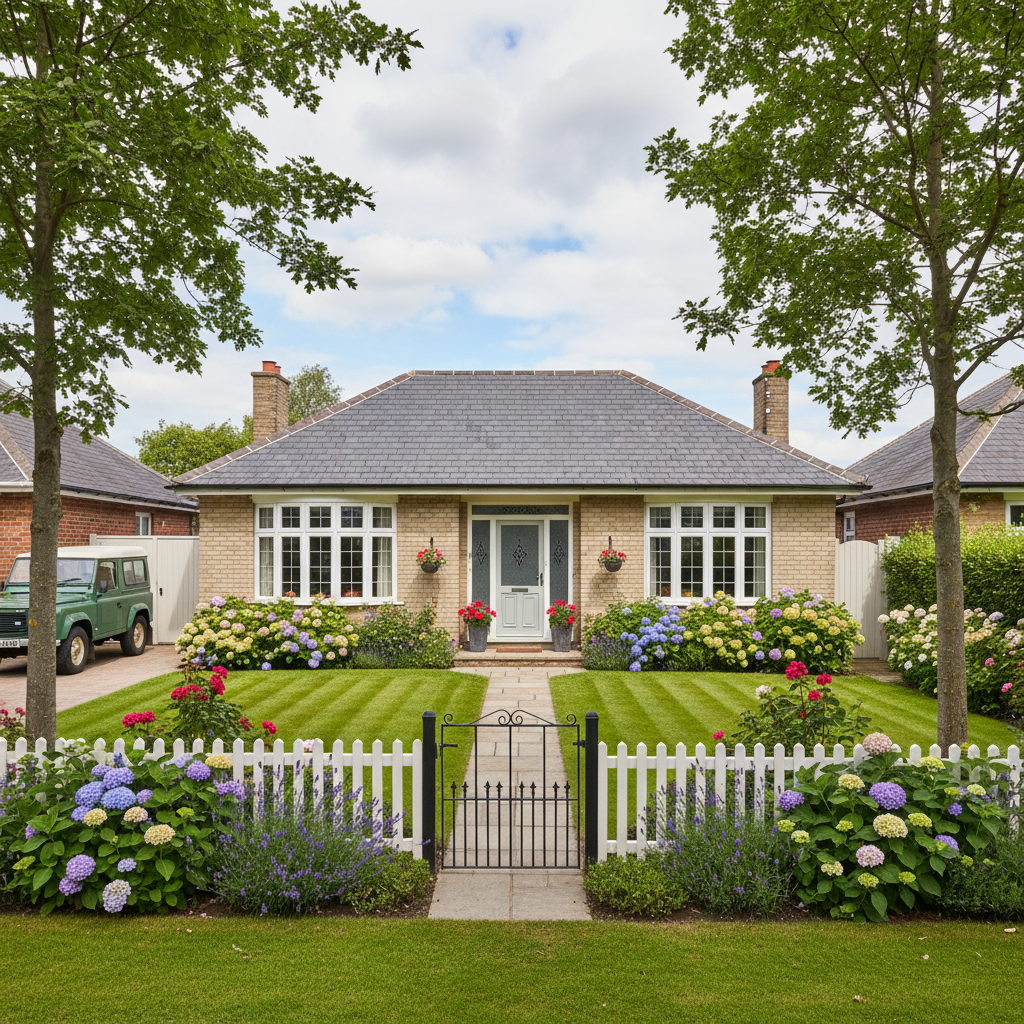
Single-storey bungalow with wide frontage and neat garden, bright British daylight, suburban street
Single Storey

Bungalow

Typically found in 1950s–1970s suburban estates, coastal towns, and rural plots.

828

sq ft

77

1–2

bedrooms

9.3×8.4m

footprint

Ground-floor footprint

9.3m8.4m

9.3m × 8.4m

77 m² footprint

828 sq ft

The bungalow is a single-storey dwelling common across UK suburbia and coastal areas. Its ground-floor footprint equals its total floor area, making it the most land-intensive type per bedroom. Popular for retirement living, accessible design, and sites with planning height restrictions.

Pros

  • +Accessible single-level living
  • +No stairs — suitable for all ages
  • +Generous garden potential
  • +Lower construction complexity

Cons

  • Large footprint per bedroom
  • Least efficient land use
  • Planning restrictions may apply
Visualise Bungalow on a plot
Semi-Detached

Semi-Detached

Semi-detached house example — Post-war suburban estate

1,033

sq ft

96

3

bedrooms

8×12.9m

footprint

Ground-floor footprint

8m12.9m

8m × 12.9m

96 m² footprint

1,033 sq ft

The most common house type in the UK, the semi-detached shares one party wall with an identical or mirrored neighbour. The 1,033 sq ft footprint reflects the UK average for this type. Suitable for family living with front and rear gardens. The reference baseline for PlotVision calculations is 1,050 sq ft — very close to this type.

Pros

  • +Most common UK house type — familiar to planners
  • +Good balance of space and land efficiency
  • +Front and rear garden
  • +Lower cost than detached

Cons

  • Shared party wall — some noise transfer
  • Less privacy than detached
  • Design constrained by mirror-image pairing
Visualise Semi-Detached on a plot
Modern detached house with double garage and large driveway, manicured lawn, bright daylight
Detached

Detached

Rural plots, executive housing estates, and large suburban plots. Requires minimum half-acre plot for comfortable garden.

1,582

sq ft

147

4

bedrooms

12.5×11.8m

footprint

Ground-floor footprint

12.5m11.8m

12.5m × 11.8m

147 m² footprint

1,582 sq ft

The detached house is a standalone dwelling with full perimeter access — no shared walls. At 1,582 sq ft, this is the largest footprint in the PlotVision dataset, representing a typical 4-bedroom family home. Requires the most land per unit but offers maximum design freedom, privacy, and planning flexibility.

Pros

  • +Maximum design freedom
  • +Full perimeter access
  • +No shared walls — maximum privacy
  • +Suitable for extensions and outbuildings

Cons

  • Largest footprint — fewest units per plot
  • Higher build cost
  • Requires larger plot for adequate garden
Visualise Detached on a plot